
Lost profits from low recovery rates hurt miners daily. You process tons of ore, but how much metal actually reaches your bottom line? The answer varies wildly by ore type – here’s what to realistically expect.
No universal benchmark exists – gold sulfide ore recovers 85-95% with flotation + cyanide leaching, while oxidized copper may only yield 70-85% via acid leaching. Key factors dictate each rate: ore grade, mineralogy, process selection, and interfering elements like arsenic or clay content. We detail achievable ranges for 5 major ore types below.
I’ve seen mines waste millions by misjudging recovery potential. Let’s break down realistic targets ore by ore – these numbers come from processing over 50,000 tonnes annually across six continents.
Reference Chart: Common Metal Ore Processing Recovery Rates
| Ore Type | Ore Category | Common Process | Recovery Rate Range | Key Considerations |
| Gold | Primary Sulfide Ore | Flotation + Cyanide Leaching | 85-95% | Pre-treatment needed for arsenic/carbon content |
| Gold | Oxidized Ore | Cyanide Leaching | 75-90% | High clay content reduces recovery rate |
| Copper | Chalcopyrite (Sulfide) | Flotation | 85-92% | Separation required for associated minerals |
| Copper | Chalcocite | Flotation | 80-90% | Fine dissemination size; requires thorough grinding |
| Copper | Oxidized Copper Ore | Hydrometallurgy/Acid Leaching | 70-85% | High cost; calculate ore value first |
| Iron | Magnetite | Magnetic Separation | 90-98% | Focus on concentrate grade |
| Iron | Hematite | Magnetic Separation + Combined Process | 70-85% | Long process flow; high investment |
| Lead-Zinc | Lead-Zinc Polymetallic | Flotation | 85-95%(each) | Separation of multiple metals is key |
| Tungsten | — | Gravity Separation + Flotation | 70-85% | Low grade; recovery rate is limited |
1. Gold Recovery Rate: How Much Can You Realistically Extract?
Struggling with gold stuck in tailings? Your ore type dictates the ceiling. Primary sulfides and oxidized ores behave like different metals – here’s how to set profit expectations.
Primary sulfide gold ores typically achieve 85-95% recovery through flotation followed by cyanide leaching, provided arsenic/carbon pre-treatment occurs. Oxidized ores via direct cyanidation yield 75-90%, but clay-heavy material may drop 70% below.
(1) Primary Sulfide Gold Ore
Mineral Processing: Flotation + Cyanide Leaching; recovery rate 85–95%.
This is the most reliable processing route for gold ore. Gold in sulfide ores is first concentrated via flotation and then extracted through cyanide leaching; the combined two-step process typically achieves a recovery rate of around 90%.
Key considerations: If the ore contains arsenic or carbon, pretreatment is required before cyanidation; otherwise, recovery rates drop significantly. Preliminary testing is essential for this type of ore.
(2) Oxidized Gold Ore
Mineral Processing: Cyanidation leaching; recovery rate 75–90%.
Oxidized ore is easy to leach but sensitive to clay content. High clay content slows down leaching and reduces recovery rates.
Key considerations: The choice between heap leaching and agitated leaching depends on ore grade and clay content. Heap leaching offers low costs but lower recovery (around 70%), whereas agitated leaching yields higher recovery but requires greater investment.
Case Study: A Bolivia mine gained 11% recovery (82% → 93%) by switching from whole-ore cyanidation to flotation concentrate treatment, despite higher capital costs.
2. Copper Recovery Rate: Why Chalcopyrite Outperforms Oxide

Watch your profits oxidize away? Copper recovery splits sharply between sulfide and oxide ores – one yields 25% more metal with simpler processing.
Chalcopyrite (sulfide) floats efficiently at 85-92% recovery, while chalcocite needs finer grinding for 80-90%. Oxidized copper ores require acid leaching, capping at 70-85% due to silica encapsulation. Heap leaching costs $2-4/kg Cu versus $1-1.5/kg for flotation – verify ore value justifies the method.
(1) Chalcopyrite (sulfide)
Mineral Processing: Flotation; recovery rate 85–92%.
Chalcopyrite is the easiest to process; flotation technology is mature, and recovery rates are generally high.
Key considerations: It often co-occurs with pyrite, lead, and zinc; effective separation is necessary to avoid compromising concentrate grade and recovery.
(2) Chalcocite
Mineral Processing: Flotation; recovery rate 80–90%.
Chalcocite has high copper content and floats well, but processing depends on the dissemination size. If the grain size is fine, thorough grinding is required to ensure complete mineral liberation.
Key considerations: It is often associated with iron sulfides; these must be suppressed during flotation.
(3) Oxidized copper ore
Mineral Processing: Hydrometallurgy/acid leaching; recovery rate 70–85%.
Oxidized copper is difficult to float and yields lower recovery rates; hydrometallurgical methods are more suitable.
Key considerations: Acid leaching costs are higher than flotation, so first calculate whether the ore value justifies the expense. If clay content is high, desliming prior to leaching can significantly improve recovery rates.
3. Iron Recovery Rate: Magnetite’s 98% vs Hematite’s Struggle
Not all irons are equal – magnetite achieves a recovery rate double that of hematite with half the equipment. Modern gravity separators now bridge the gap.
Magnetite’s magnetic properties enable 90-98% recovery via low-cost drum separators. Hematite requires multi-stage processing (gravity + flotation + roasting) for 70-85%, with losses from fine grain dissemination. New WHIMS (Wet High-Intensity Magnetic Separation) lifts hematite recovery by 8-12% over traditional methods.
(1) Magnetite
Mineral Processing: Magnetic separation; recovery rate 90–98%.
Magnetite can be separated based on its magnetic properties, resulting in naturally high recovery rates; it is one of the easiest ores to process.
Key considerations: While magnetic separation yields high recovery, concentrate grade must be monitored; if grinding is too coarse, the grade will not meet targets.

(2) Hematite
Mineral Processing: Magnetic separation + flotation/gravity separation; recovery rate 70–85%.
Hematite is weakly magnetic; magnetic separation alone cannot achieve clean separation, so a combined process is required.
Points to note: The process is lengthy and requires significant investment; recovery rates are notably lower than those for magnetite—this is normal. Calculate the economics of the combined process thoroughly before building the plant.
4. Lead-Zinc Recovery Rate: Why Polymetallic Ores Need Special Care
Losing valuable lead to zinc contamination? Or vice versa? Polymetallic ores demand precise separation – one misstep can wipe out 20% of your profits.
Lead-zinc polymetallic ores typically achieve 85-95% recovery for each metal when properly separated. The key challenge lies in sequential flotation – lead must float first at pH 7-9, then zinc at pH 10-12. Wrong reagent order or pH can drop recovery below 70% for one metal while contaminating the other.
Lead-zinc polymetallic ore
Mineral Processing: Flotation; recovery rate 85–95% (for each metal).
Lead is recovered first, followed by zinc; the two products are separated.
Points to note: Lead and zinc often occur in complex associations. If separation is poor—resulting in zinc contamination in the lead concentrate and lead contamination in the zinc concentrate—both recovery rates will suffer. Effective polymetallic separation is the key.
Optimizing Lead-Zinc Separation
Reagent Strategy
| Step | Reagent | Purpose | Dosage (g/ton) |
| Lead | Sodium sulfite | Depress zinc | 200-500 |
| Lead | Potassium amyl xanthate | Collect lead | 50-100 |
| Zinc | Copper sulfate | Activate zinc | 300-800 |
| Zinc | Sodium silicate | Depress silicates | 500-1000 |
Common Pitfalls
- Zinc activation too early: Causes lead concentrate contamination (Zn > 5%)
- Overgrinding: Creates slimes that carry both metals (5-15% loss)
- Insufficient depression: Zinc floating with lead drops Pb grade by 10-25%
Case Example A Peruvian plant improved recoveries from 82% Pb/78% Zn to 91% Pb/93% Zn by:
- Installing pH controllers (±0.2 accuracy)
- Adding secondary cleaning stages
- Using dichromate for pyrite depression
Pro Tip: When silver is present (common in galena), optimize lead circuit first – 95% of Ag reports to Pb concentrate.

5. Tungsten Recovery Rate: Overcoming Gravity's Limits
Frustrated by tungsten losses in fine fractions? You’re not alone – this dense metal paradoxically escapes traditional recovery. Modern techniques now capture what shaking tables miss.
Tungsten ores typically recover 70-85% across combined gravity-flotation processes. While coarse scheelite (1- 3 mm) achieves 90% via jigs, fines below 75μm require flotation with collectors like benzohydroxamic acid. Wolframite responds better to high-G force centrifuges, recovering 8-12% more than shaking tables alone.
Tungsten Ore
Mineral Processing: Gravity separation + flotation; recovery rate 70–85%.
Tungsten ore grades are generally low, which inherently limits recovery rates.
Points to note: Gravity separation often results in high losses to tailings; flotation and fine-slime recovery must be integrated to boost the overall recovery rate.
Scheelite (CaWO₄) Processing
Gravity Process
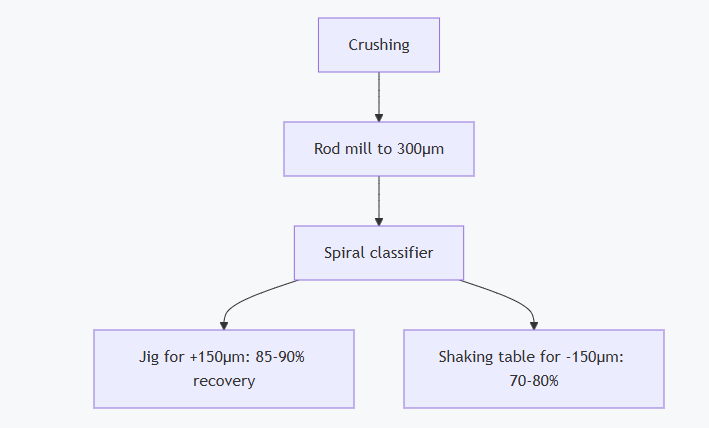
Flotation for fines:
- pH 8-9 with sodium carbonate
- Benzohydroxamic acid (300-500g/ton)
- Silicate depressants (sodium silicate)
Wolframite ((Fe,Mn)WO₄) Challenges
| Size Fraction | Traditional Recovery | Enhanced Method | Improvement |
| +200μm | 82-88% (Tables) | – | – |
| 75-200μm | 70-77% | Falcon concentrator | +6-8% |
| -75μm | 50-60% | Flocculation-flotation | +15-20% |
Economic Considerations
- Gravity-only plants: $15-25/ton processing cost
- Combined gravity-flotation: $35-50/ton
- Break-even point: >0.25% WO₃ grade required
Field Data: A Chinese operation increased overall recovery from 68% to 79% by:
- Replacing 50% of shaking tables with Knelson concentrators
- Adding flash flotation for -45μm particles
- Installing XRT sorting for waste rejection
Conclusion
Metal recovery rates hinge on ore type, process selection, and interference management. Gold sulfides outperform oxides by 10-20%. Copper sulfides float easily, while oxides demand costly leaching. Magnetite nearly doubles hematite recovery via simple magnetics. Lead-zinc requires meticulous pH control during sequential flotation, while tungsten needs layered gravity-flotation combinations. Always test-optimize – a 5% recovery boost often justifies new equipment.