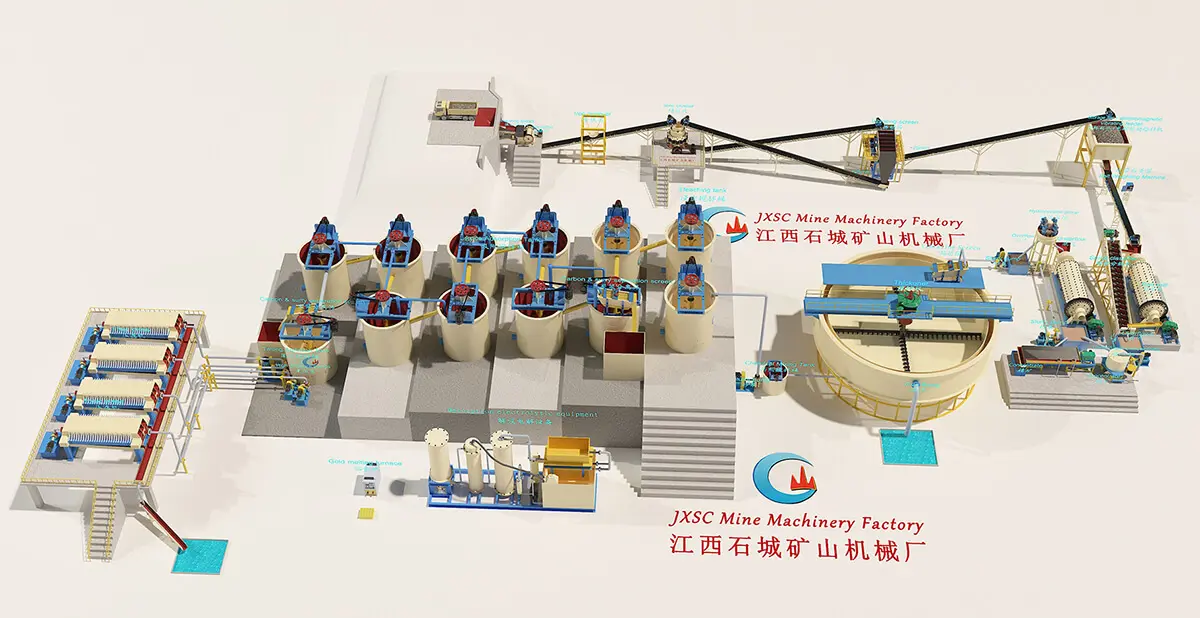
Garnet ore beneficiation is a mineral processing process designed for this type of island-like silicate non-metallic mineral. Based on the different occurrence characteristics of alluvial and bedrock deposits, it employs a combination of processes—including crushing, screening, gravity separation, magnetic separation, and flotation—to achieve efficient separation and purification of garnet from gangue and impurities. The final product is a qualified concentrate suitable for various applications, such as gemstone processing, industrial abrasives, and filter media.
Garnet is a group of silicate minerals renowned for their hardness, durability, and vibrant colors. Although commonly recognized as gemstones, the majority of garnet production is dedicated to industrial applications due to its exceptional physical properties, such as high hardness (6.5–7.5 on the Mohs scale) and chemical stability. Garnets are found in metamorphic, igneous, and sedimentary deposits worldwide, making them both geologically significant and commercially valuable.
Types of Garnet
Garnets share a similar crystal structure but vary in chemical composition, leading to different varieties:
Almandine(Fe₃Al₂Si₃O₁₂) – Deep red to brownish-red, common in metamorphic rocks.
Pyrope(Mg₃Al₂Si₃O₁₂) – Deep red, often found in kimberlites and mantle-derived rocks.
Spessartine(Mn₃Al₂Si₃O₁₂) – Orange to reddish-brown, formed in granite pegmatites.
Grossular(Ca₃Al₂Si₃O₁₂) – Ranges from white to green (e.g., Tsavorite, a rare gem-quality variety).
Andradite(Ca₃Fe₂Si₃O₁₂) – Yellow, green, or brown, valued for its hardness.
Uvarovite(Ca₃Cr₂Si₃O₁₂) – Emerald-green, chromium-rich, rare and collectible.
Key Characteristics
Crystal Structure: Isometric, typically forming dodecahedral or trapezohedral crystals.
Hardness:5–7.5 (Mohs scale), making it ideal for abrasives and cutting tools.
Density:5–4.3 g/cm³, allowing for gravity-based separation in mining.
Chemical Resistance: Stable under high temperatures and chemical exposure.
Industrial & Gemological Uses
Abrasives & Polishing– Used in sandpaper, grinding wheels, and polishing compounds.
Water Jet Cutting– Garnet is the preferred abrasive for precision cutting of metals.
Filtration Media– Heavy density makes it ideal for water and wastewater treatment.
Gemstones– A small fraction becomes fine jewelry (e.g., Rhodolite, Demantoid).
High-Tech Applications– Synthetic garnets are used in lasers, sensors, and solid-state batteries.
Mineral Processing
Garnet Mineral Processing System: From Raw Ore to Gemstones and Abrasive Products
Unlike many mineral processing plants that focus on a single end product, a garnet mineral processing system is an integrated production line capable of converting raw ore into two distinct product categories through parallel yet fundamentally different processing routes:
Gem-grade faceted and cabochon garnets, produced through careful beneficiation and hand selection.
Industrial-grade garnet abrasives are manufactured into graded sands and micronized powders through crushing, grinding, and precision classification.
The selection of the processing route depends on several factors, including ore type, crystal size, mineral composition, color, purity, and the intended end use.
Overview of the Garnet Mineral Processing System
A modern garnet processing plant generally consists of ore preparation, mineral separation, product upgrading, and final packaging. After mining, the raw ore is first cleaned and classified before entering different processing circuits – gemstone processing or abrasive processing.
The objective of gemstone processing is to preserve the natural integrity of garnet crystals while maximizing their commercial value.
1. Ore Washing Trommel scrubbers or log washers remove clay, weathered materials, and surface contaminants from the mined ore.
2. Primary Crystal Sorting Large, intact garnet crystals are manually selected or separated using optical sorting equipment before any crushing operation to prevent crystal damage.
3. Mineral Beneficiation Depending on the deposit characteristics, several beneficiation techniques may be employed to remove gangue minerals and concentrate garnet crystals, including:
Heavy media separation
Gravity separation
Magnetic separation
X-ray sorting
Optical sorting
These processes effectively eliminate quartz, feldspar, mica, amphibole, and other unwanted minerals.
4. Crystal Recovery and Gemstone Manufacturing Recovered garnet crystals are graded, cut, shaped, and polished into finished gemstones suitable for jewelry and decorative applications.
Route 2: Abrasive Processing
Typical Process Flow: Raw Ore → Crushing → Grinding → Screening → Gravity & Magnetic Separation → Drying → Grain Classification → Abrasive Garnet Products
Unlike gemstone production, abrasive processing focuses on producing high-purity garnet particles with controlled particle size, hardness, and shape.
1. Primary Crushing Jaw crushers reduce large rocks into manageable sizes.
2. Secondary Crushing Cone crushers or impact crushers further reduce the material while preserving garnet liberation.
3. Grinding Rod mills or ball mills liberate garnet from associated minerals.
4. Screening Vibrating screens classify materials into different size fractions.
5. Gravity Separation Since garnet has a relatively high specific gravity (approximately 3.5–4.3), gravity separators effectively concentrate garnet while rejecting lighter gangue minerals.
6. Magnetic Separation Weakly magnetic impurities such as ilmenite, magnetite, and iron-bearing minerals are removed.
7. Drying and Particle Classification The concentrated garnet is dried and precisely classified into different grit sizes or micronized powders according to customer specifications.
Garnet Processing Methods by Deposit Type
The processing technology also varies depending on the geological occurrence of the garnet deposit.
Garnet Placer Deposits Processing
Placer deposits are formed through natural weathering and hydraulic transportation. Since the garnet grains are already liberated from the host rock, crushing is generally unnecessary, making the process relatively simple and cost-effective.
Typical Placer Processing Flow:
Feeding → Washing → Screening → Gravity Separation → Magnetic Separation → Drying → Size Classification → Final Products
Garnet Hard Rock Deposits Processing
Hard rock garnet occurs in metamorphic rocks such as garnet schist, gneiss, amphibolite, and eclogite. The garnet crystals are firmly embedded within the host rock and must be liberated through crushing and grinding. The processing route is therefore considerably more complex.
This complete 50TPH garnet crushing & screening Plant features a four-stage processing system: Feeding, Primary Crushing, Secondary/Tertiary Crushing, and Multi-Stage Screening.
The process begins with garnet ore being fed into the raw material hopper, where a vibrating feeder below ensures consistent, controlled delivery to the primary jaw crusher. The jaw crusher performs initial size reduction, with crushed output conveyed to the secondary cone crusher for finer processing. Material then progresses to the tertiary crushing stage using a double roller crusher before being fed to the main vibrating screen.
The three-deck vibrating screen (25mm/12mm/4.5mm mesh sizes) classifies materials precisely:
Undersized material (0- 4.5 mm) advances to the linear vibrating screen for final grading
Mid-size material (4.5- 25 mm) recirculates to the double roller crusher
Oversized particles (+25mm) return to the cone crusher for further reduction
Final product sizing occurs at the two-deck linear vibrating screen (3mm/1mm mesh), allowing customizable product grades:
0- 1 mm fine garnet
1- 3 mm medium grade
3- 4.5 mm coarse grade
This well-optimized closed-circuit system efficiently processes garnet while maintaining flexibility for specific product requirements. Plant capacity can be adjusted from 30TPH to 75TPH based on application needs. The robust configuration ensures reliable operation for processing various hard minerals beyond garnet, including quartz and corundum.