
Tailings management is a critical part of modern mining operations. A well-designed tailings storage facility (TSF) must safely contain mineral-processing waste while supporting water clarification, water recovery, environmental protection, and long-term mine-site management.
Traditional tailings ponds rely on engineered dams and impoundments to store slurry tailings. However, as mines face increasing requirements for water conservation, land-use efficiency, environmental protection, and dam safety, tailings dry stacking has become an increasingly important alternative to conventional wet tailings storage.
Whether a mine uses a conventional tailings pond, a centerline or downstream tailings dam, or a dry stack tailings system, the design should consider the complete tailings management cycle—from tailings production and dewatering to storage, drainage, monitoring, closure, and reclamation.
This article explains the major principles of tailings pond design, including tailings facility classification, initial dam construction, embankment raising methods, stability and seepage control, flood prevention, drainage systems, and the role of JXSC’s tailings dry stacking solution in improving tailings management and reducing dependence on large water-filled impoundments.
Classification and Grading of Tailings Ponds
1. What’s a Tailings Pond?
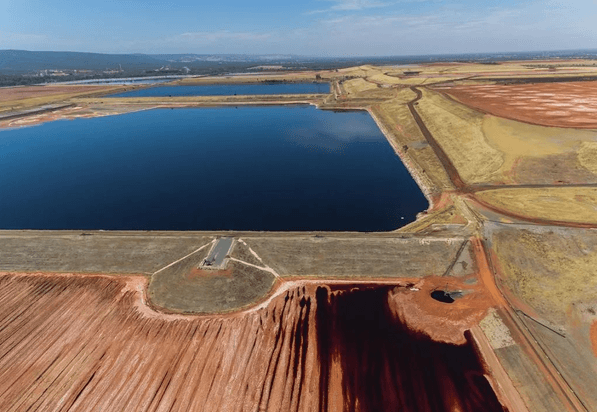
A tailings pond refers to a dedicated site and its supporting structures used for storing slurry tailings generated during mineral processing. It typically consists of a tailings storage area, tailings dams (initial dams and raised embankments), drainage structures, and monitoring facilities, serving important functions such as tailings storage, water clarification, and environmental protection.
In the tailings pond system, the initial dam is constructed during the infrastructure phase to create the initial storage capacity. As production progresses, the raised embankment is built using tailings sand. The design capacity of the tailings pond must meet the storage needs of all tailings during the mine’s service life while considering necessary flood regulation capacity and safety freeboard.
2. Classification of Tailings Ponds
Based on terrain conditions, tailings ponds can be divided into three types: valley-type, flat-type, and hillside-type.
- Valley-type tailings ponds utilize natural gullies and constructed dams to form storage capacity, offering advantages such as low engineering volume and cost savings.
- Flat-type tailings ponds require dams on all sides
- Hillside-type ponds fall between the valley-type and flat-type tailings ponds.
According to the construction method, tailings ponds can be further classified as upstream, centerline, or downstream embankments.
- Upstream embankment construction is the most common, with simple construction but relatively lower stability.
- Downstream embankments offer the best stability but require more construction materials.
- Centerline embankments combine the characteristics of upstream and downstream embankments.

3. Grading of Tailings Ponds
The design classification for the service life of a tailings dam should be determined based on the total storage capacity and dam height for that period:
| Class | Total Storage Capacity (10,000 m³) | Dam Height (m) |
| L1 | ≥50000 | ≥200 |
| L2 | ≥10000,<50000 | ≥100, <200 |
| L3 | ≥1000, <10000 | ≥60, <100 |
| L4 | ≥100, <1000 | ≥30, <60 |
| L5 | <100 | <30 |
Rules for determining classification:
- When the difference in classification levels determined separately by reservoir capacity and dam height is one level, the higher classification shall prevail.
- When the difference exceeds one level, the classification shall be lowered by one level based on the higher value.
- For tailings dams where a failure would cause severe disasters to important downstream towns, industrial and mining enterprises, or major railway lines, the classification may be raised by one level following a feasibility study.
Tailings Dam Design
1. Initial Dam Design
The initial dam serves as the first barrier for tailings ponds, typically constructed using impermeable or slightly permeable local materials. Key design factors include foundation treatment, dam cross-sections, and phreatic line control. Impermeable dam types enhance stability but require proper drainage measures to lower the phreatic line.
The height of the initial dam must balance engineering investment and safety margins. Excessive height leads to unnecessary investment waste, while insufficient height may accelerate dam-raising progress, affecting tailings deposition patterns and dam stability.
2. Raised Embankments Design
Raised embankments are typically constructed using upstream, centerline, or downstream methods. Upstream embankments are simpler to build but less stable, while centerline and downstream methods create more stable structures. Design must consider tailings properties, terrain conditions, and construction techniques.
Key design aspects for raised embankments include determining appropriate slopes, staged raising plans, and surface drainage systems. Slope stability analysis should account for various working conditions, including the most unfavorable scenarios, and consider occasional loads such as earthquakes.
3. Comparison of Different Construction Methods
Centerline and downstream tailings dams offer distinct advantages over conventional upstream dams. Centerline construction places stable coarse tailings in the middle of the dam, resisting water pressure from both sides and enhancing overall stability. Downstream dams position high-strength coarse tailings on the downstream side, providing better slip resistance, making them particularly suitable for high-dam construction.
The choice of construction method should consider tailings particle size, site topography, seismic intensity, and other factors. In high-seismic zones, downstream dams are preferred due to their superior earthquake resistance.
4. Dam Body Stability Analysis
The safety analysis of a tailings dam should include:
- Seepage analysis: Determining the location of the seepage line, seepage flow rate, and seepage stability
- Sliding Stability Analysis: Verification of the dam’s safety factor against sliding under various operating conditions
Depending on the dam type and technical requirements, the stability analysis must also consider the following special conditions:
- Compacted dam material properties (control parameters such as dry unit weight, compaction degree, and porosity).
- In seismic zones, the seismic surge height must also be included.
Design Standards for Flood Prevention and Drainage Systems

Flood management is one of the most important components of conventional tailings pond design.
The design flood standard should be determined according to the applicable national or regional regulations, tailings facility classification, dam height, downstream consequences, hydrological conditions, and environmental risk.
For high-consequence facilities, more conservative flood criteria may be required, potentially including a Probable Maximum Flood (PMF) assessment.
1. Flood Control Standards
The flood control standards for each service life period of the tailings dam are as follows:
| Tailings Dam Classification | Flood Return Period (years) |
| Ⅰ | 1,000–5,000 or PMF (Probable Maximum Flood) |
| Ⅱ | 500~1000 |
| Ⅲ | 200~500 |
| Ⅳ | 100~200 |
| Ⅴ | 100 |
Rules for Adjusting Flood Control Standards:
- The flood control standard may be raised by one grade when the dam is a high-fill dam or when there are important residential areas downstream.
- If a tailings dam failure would cause extremely severe harm to the downstream environment, the design may be based on a PMF.
- When tailings are stored in an abandoned open-pit mine, and no dam has been constructed around it, the flood control standard is a once-in-a-century event.
2. Flood Drainage Facilities
Tailings dams must be equipped with flood drainage facilities; mechanical flood drainage is not permitted.
Components of a Flood Control System
| Intake Structures | Conveyance Structures |
| Drainage Wells (frame-type, window-type, block-type, stacked-ring-type) | Drainage Pipes (circular, rectangular, circular arch with straight walls) |
| Drainage Channels (arched cover, flat cover) | Flood discharge tunnels (lined/unlined/partially lined) |
| Spillways (reinforced concrete/mortar-jointed rubble masonry) | Flood diversion ditches |
| Slope flood diversion ditches | — |
The internal diameter of a drainage shaft should not be less than 1.5 m. The clear height of a drainage pipe or inclined chute should not be less than 1.2 m. The clear height of a flood discharge tunnel should not be less than 1.8 m, the clear width should not be less than 1.5 m, and the minimum design gradient should not be less than 0.3%.
Special Provisions
- Tailings dams of Class III and above shall not use flood-interception ditches for flood discharge.
- When drainage shafts in the dam’s internal flood discharge system are taken out of service, they shall be sealed at the top of the shaft head, within the shaft head, or inside the adit.
- The sealing structure shall not be located at the top of the shaft.
3. Key Steps in Flood Regulation Calculations
Flood regulation calculations simulate water level changes during storms to verify the adequacy of storage capacity and discharge facilities. Steps include:
- Develop design storm hydrographs
- Calculate inflow flood hydrographs
- Perform reservoir regulation calculations
- Verify discharge capacity
Calculations should account for worst-case scenarios, such as reduced storage due to sedimentation or partial clogging of drainage facilities. In recent years, computer simulations have been widely used for more accurate flood routing predictions.
Tailings Dry Stacking: An Alternative to Conventional Tailings Ponds
Conventional tailings ponds store tailings as a slurry with a significant amount of process water. Although widely used, large water-retaining facilities can create challenges related to dam safety, water management, land occupation, seepage, and closure.
Tailings dry stacking, also called dry stack tailings, provides an alternative approach.
Instead of pumping low-density slurry directly into a large impoundment, the tailings are first dewatered to produce a relatively dry filter cake or low-moisture tailings product. The dewatered tailings can then be transported, stacked, compacted, and managed as a dry storage facility.
A typical dry stacking process includes:
Mineral Processing → Tailings Thickening → Tailings Dewatering → Filter Cake → Transportation → Dry Stacking → Compaction/Water Management
The specific process configuration depends on tailings mineralogy, particle-size distribution, throughput, water chemistry, moisture requirements, and site conditions.
JXSC Tailings Dry Stacking Solution
JXSC provides mineral processing and tailings management solutions that can be integrated into projects requiring more efficient tailings dewatering and dry stacking.
JXSC’s tailings dry stacking solution can be designed around the complete tailings treatment process rather than treating dewatering as an isolated equipment selection problem.

Tailings Pond vs. Dry Stacking
| Factor | Conventional Tailings Pond | Tailings Dry Stacking |
| Tailings condition | Slurry | Dewatered/filter cake |
| Water stored with tailings | Relatively high | Relatively low |
| Major containment structure | Tailings dam/embankment | Engineered dry stack |
| Water recovery | Moderate to high depending on system | Generally high potential |
| Dam-related risk | Important design consideration | Reduced reliance on large water-retaining dams |
| Land requirements | Site-specific | Potentially smaller footprint |
| Dewatering equipment | Limited or optional | Essential |
| Climate sensitivity | Flood and water management are critical | Rainfall and moisture management are critical |
| Closure approach | Requires long-term impoundment management | May facilitate progressive reclamation |
| Capital and operating cost | Often lower dewatering cost | Higher dewatering/filtration requirements |
Conclusion
A safe and efficient tailings management system requires more than simply constructing a dam around a storage area. Tailings pond design must integrate site selection, dam construction, tailings deposition, seepage control, slope stability, flood protection, drainage, monitoring, operation, and closure planning.
For conventional tailings storage facilities, the selection of the appropriate dam-raising method—upstream, centerline, or downstream—should be based on tailings properties, geotechnical conditions, seismic risk, water management, and applicable regulations.
At the same time, tailings dry stacking provides an increasingly important alternative for mines seeking to reduce water storage, improve water recovery, and reduce their dependence on large water-retaining tailings dams.
With an integrated approach to tailings dewatering, filtration, water recovery, and dry stacking, JXSC can support mining projects in developing tailings management systems that are better aligned with site conditions, production requirements, water-management objectives, and long-term environmental considerations.