
Total iron (TFe) determination is a fundamental analytical procedure in iron ore testing, mineral processing, beneficiation plant operations, and quality control. Accurate measurement of total iron content helps mining companies evaluate ore grades, monitor beneficiation performance, verify product quality, and optimize processing parameters.
Three commonly used methods for determining total iron in iron ore are potassium dichromate titration, cerium sulfate titration, and UV-Visible spectrophotometry. Each method has different analytical principles, reagent requirements, operating procedures, and application scenarios.
This article explains how these methods work, outlines their main analytical steps, compares their advantages and limitations, and introduces the laboratory equipment required for iron ore analysis.
What Is Total Iron (TFe) in Iron Ore?
Total iron (TFe) refers to the total iron content in an iron ore sample, expressed as a percentage by mass. It includes iron present in different mineral phases and oxidation states, such as hematite (Fe₂O₃), magnetite (Fe₃O₄), and other iron-bearing minerals.
TFe is one of the most important indicators of iron ore quality. It is widely used in:
- Iron ore grade evaluation and commercial trading.
- Mineral processing and beneficiation performance assessment.
- Laboratory quality control and metallurgical testing.
- Iron ore blending and process optimization.
- Mining project evaluation and production monitoring.

Reliable TFe analysis requires representative sampling, effective sample digestion, appropriate analytical reagents, and accurate measurement.
Three Methods for Determining Total Iron (TFe) in Iron Ore
Method 1: Potassium Dichromate Titration for Total Iron Determination
Potassium dichromate titration is a classical volumetric method for determining total iron in iron ore. It is based on the reduction of ferric iron (Fe³⁺) to ferrous iron (Fe²⁺), followed by titration with a standardized potassium dichromate solution.
1. Analytical Principle
After the iron ore is dissolved using a mixed sulfuric-phosphoric acid and nitric acid solution, most of the Fe³⁺ is first reduced using a SnCl₂ solution. To control the amount of SnCl₂ used, SnCl₂ is added until the solution turns pale yellow (indicating that a small amount of Fe³⁺ remains at this point). Then, a TiCl₃ solution is added to reduce the remaining iron to Fe²⁺. To ensure the reaction is complete, TiCl₃ must be used in excess. The excess TiCl₃ solution is then oxidized and removed by trace copper ions, which catalyze the reaction with dissolved oxygen in the solution. This process is indicated by the indicator sodium isatin disulfate turning blue, signifying that the TiCl₃ has been completely removed.
The reaction equations are:
2Fe³⁺ + Sn²⁺ + 6Cl⁻ = 2Fe²⁺ + SnCl₆²⁻; Fe³⁺ + Ti³⁺ + H₂O = Fe²⁺ + TiO₂⁺ + 2H⁺
2. Reagents
- 10% SnCl₂ solution: Dissolve 10 g of solid SnCl₂•2H₂O in 50 mL of concentrated hydrochloric acid, dilute with water to 100 mL, and add a few grains of pure tin.
- 1:1 TiCl₃ solution: Mix a commercially available TiCl₃ solution with an equal volume of hydrochloric acid (1:1).
- CuSO₄ solution: 0.2%
- Sodium isothiocyanate indicator: Dissolve 0.25 g of the indicator in 100 mL of water and add 5 drops of a 1:1 H₂SO₄ solution.
- Sulfuric-phosphoric acid mixture (1:1): Slowly add 150 mL of concentrated sulfuric acid to 700 mL of water; after cooling, add 150 mL of concentrated phosphoric acid.
- Concentrated nitric acid
- Sodium diphenylamine sulfonate indicator (0.5%)
- HCl (concentrated)
3. Analytical Procedure
Step 1: Prepare the potassium dichromate standard solution
Dry potassium dichromate under the specified conditions, cool it in a desiccator, accurately weigh the required amount, dissolve it in distilled water, and dilute to a defined volume in a volumetric flask.
Step 2: Dissolve the iron ore sample
Accurately weigh approximately 0.2–0.3 g of the prepared sample into a conical flask. Add concentrated hydrochloric acid and heat gently to dissolve the sample according to the applicable method.
Step 3: Reduce ferric iron
While the solution is hot, add stannous chloride dropwise until the yellow color becomes pale yellow. Add titanium(III) chloride carefully until the ferric iron color disappears, following the prescribed endpoint procedure.
Step 4: Remove excess reducing agent
Cool the solution, add water and the sulfuric acid-phosphoric acid mixture, and introduce the specified indicator and copper sulfate catalyst. Follow the validated procedure to ensure that excess titanium(III) has been eliminated before titration.
Step 5: Perform the titration
Add sodium diphenylamine sulfonate indicator and titrate with standardized potassium dichromate solution until the prescribed violet endpoint is reached.
Step 6: Calculate total iron content
Calculate TFe from the titrant concentration or iron titration factor, the volume consumed, and the original sample mass. Apply any required blank and correction factors.
4. Advantages and Limitations
Potassium dichromate titration offers good analytical accuracy when the procedure is carefully controlled. It is suitable for routine iron ore analysis and does not require an advanced optical instrument.
However, the method involves several chemical reagents and multiple reduction and indicator steps. Accurate endpoint recognition, titrant standardization, and interference control are essential. Dichromate contains hexavalent chromium, which presents significant health and environmental hazards and requires appropriate handling and waste management.
Method 2: Cerium Sulfate Titration for Total Iron Determination
Cerium sulfate titration is another volumetric method for measuring total iron in iron ore.This method may be useful for certain iron ore samples, including samples containing substantial amounts of arsenic, when the analytical procedure has been validated for the sample matrix.
1. Analytical Principle
The iron ore sample is decomposed using hydrochloric acid. Ferric iron is reduced to ferrous iron using stannous chloride.
The ferrous iron is then titrated with standardized cerium(IV) sulfate solution in an acidic medium.
The principal redox reaction is:
Ce⁴⁺ + Fe²⁺ → Ce³⁺ + Fe³⁺
Cerium(IV) accepts one electron from ferrous iron, while ferrous iron is oxidized to ferric iron. The stoichiometric relationship is therefore one mole of Ce⁴⁺ per mole of Fe²⁺.
Sodium diphenylamine sulfonate is used as the endpoint indicator in the specified procedure.
2. Main Reagents
- 1 mol/L Cerium Sulfate Standard Solution: Weigh 40.4 g of cerium sulfate [Ce(SO₄)₂·4H₂O], place it in a 200-mL beaker, dissolve it in 1% sulfuric acid, dilute to 1000 mL, and shake well.
- 2% Ammonium Hydroxide–Ammonium Chloride Solution: Dissolve 2 g of ammonium chloride in 100 mL of 2% ammonium hydroxide solution.
- 15% Stannous Chloride Solution: Dissolve 15 g of stannous chloride (SnCl₂·2H₂O) in 30 mL of hydrochloric acid, then dilute with water to 100 mL.
- 5% Mercuric Chloride Solution: Dissolve 5 g of mercuric chloride in 100 mL of water.
- Sulfuric-Phosphoric Acid Mixture: Slowly pour 150 mL of concentrated sulfuric acid into 700 mL of water; after cooling, add 150 mL of phosphoric acid and stir thoroughly.
- 1% Sodium Diphenylaminesulfonate Solution
3. Analytical Procedure
Step 1: Weigh the sample
Accurately weigh approximately 0.3 g of prepared iron ore into a 250 mL conical flask.
Step 2: Digest the sample
Add concentrated hydrochloric acid, cover the flask with a watch glass, and heat on a laboratory hot plate for the specified digestion period.
Step 3: Reduce ferric iron
Add stannous chloride solution according to the validated method to reduce ferric iron to ferrous iron. Any subsequent treatment used to remove excess reducing agent must follow the prescribed procedure.
Step 4: Adjust the solution
Add the sulfuric acid-phosphoric acid mixture and dilute the solution with water to the required volume.
Step 5: Titrate the solution
Add sodium diphenylamine sulfonate indicator and titrate with standardized cerium sulfate solution until the specified violet endpoint is reached.
Step 6: Calculate TFe
Use the volume of cerium sulfate consumed, its standardized iron titration factor, and the sample mass to calculate total iron content.
4. Advantages and Limitations
Cerium sulfate titration provides a direct redox measurement and can be useful when a validated method is needed for specific sample compositions.
Its reliability depends on complete sample decomposition, accurate reduction of ferric iron, effective control of excess reducing agents, and correct endpoint recognition.
The method may also involve hazardous reagents. In particular, any use of mercuric chloride requires strict controls and appropriate waste treatment. The method’s suitability for arsenic-rich samples must be confirmed for the actual ore matrix rather than assumed for every arsenic-bearing material.

Method 3: UV-Visible Spectrophotometry for Total Iron Determination
UV-Visible spectrophotometry is an instrumental method for determining iron concentration based on the absorption of light by a colored iron complex.
When an appropriate color-forming reagent is used, this technique can provide a convenient approach to iron analysis, particularly when a laboratory needs to process multiple samples using a calibration curve.
1. Analytical Principle
The determination was performed using ultraviolet spectrophotometry at a wavelength of 510 nm. Iron exhibited a good linear relationship with absorbance in the range of 1.20–2.80 µg/mL. The regression equation is: A = 0.200902C + 3.53 × 10, with an R² value of 0.9999. The established method is simple, rapid, and accurate, making it suitable for the analysis of iron ore.
2. Main Instruments and Reagents
- UV spectrophotometer
- ED36 electric digestion unit
- Ammonium iron(II) sulfate (A.R.)
- Sodium acetate (A.R.)
- Acetic acid (A.R.)
- Hydrochloric acid (A.R.)
- Nitric acid (A.R.)
- o-Phenanthroline (A.R.)
- Iron ore samples provided by the customer
- Water (Millipore ultrapure water prepared in-house)
3. Analytical Procedure
Step 1: Prepare the calibration curve.
Prepare a series of iron standard solutions covering the intended working range. Add hydroxylamine hydrochloride, acetate buffer, and 1,10-phenanthroline in accordance with the analytical procedure.
Dilute each solution to a defined volume with high-purity water.
Measure the absorbance of the standards at 510 nm and construct a calibration curve by plotting absorbance against iron concentration.
Step 2: Digest the iron ore sample.
Accurately weigh approximately 0.1000 g of prepared iron ore into a suitable digestion vessel.
Add hydrochloric acid and heat under controlled conditions. Subsequently add nitric acid according to the validated digestion procedure and continue heating until the sample has been adequately decomposed.
Avoid uncontrolled evaporation or loss of analyte. After digestion, cool the solution and quantitatively transfer it into a 200 mL volumetric flask. Dilute to the mark and mix thoroughly.
Step 3: Prepare the measurement solution.
Transfer an appropriate aliquot of the sample digest into a 100 mL volumetric flask.
Add hydroxylamine hydrochloride, acetate buffer, and 1,10-phenanthroline solution in the same proportions used for the calibration standards.
Dilute to the mark with high-purity water and allow the color to develop for the validated reaction time.
Step 4: Measure absorbance.
Measure the absorbance at 510 nm against the appropriate reagent blank.
Ensure that the sample absorbance falls within the validated calibration range. If necessary, dilute the sample solution and repeat the measurement.
Step 5: Calculate total iron content.
Determine the iron concentration from the calibration equation, account for all dilution steps, and calculate the TFe percentage in the original sample.
4. Advantages and Limitations
UV-Visible spectrophotometry offers convenient instrumental measurement, a straightforward calibration-based calculation, and good potential for repeatable routine analysis.
However, the method requires effective sample digestion, consistent color development, suitable calibration standards, and control of matrix interferences.
The stated wavelength of 510 nm is appropriate for the iron-phenanthroline complex under suitable conditions. The working range and calibration equation must be verified experimentally for the actual instrument, reagents, and sample preparation procedure.
Laboratory Equipment for Iron Ore Testing and Beneficiation
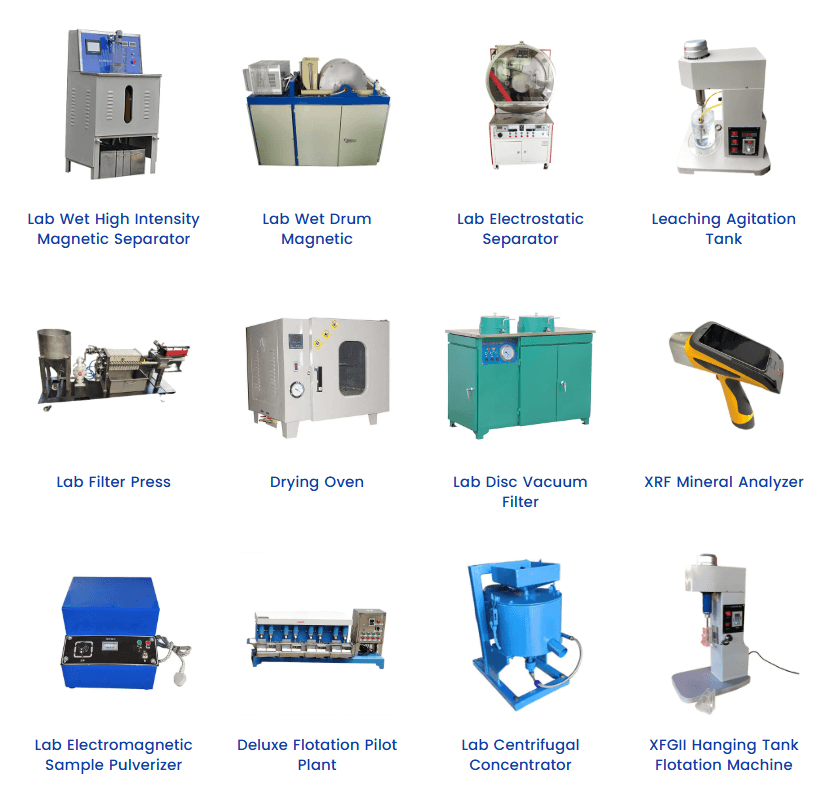
Accurate TFe analysis is part of a broader iron ore testing workflow. Before chemical analysis, representative samples must be collected, reduced, crushed, ground, and homogenized as required by the test procedure.
Depending on the testing objective, a mineral laboratory may require:
- Laboratory jaw crushers for primary sample size reduction.
- Pulverizers and laboratory grinding mills for sample preparation.
- Sieves and screening equipment for particle size analysis.
- Magnetic separation equipment for evaluating magnetic iron minerals.
- Gravity separation equipment for investigating density-based beneficiation.
- Laboratory balances, digestion equipment, and analytical instruments for chemical testing.
These instruments help laboratories investigate ore characteristics and evaluate beneficiation performance. However, crushing, grinding, and separation equipment do not directly determine TFe; the final iron grade must be measured using an appropriate, validated analytical method.
JXSC: Mining Equipment and Mineral Laboratory Solutions
JXSC Mine Machinery Factory is a mining equipment supplier with more than 40 years of industry experience, providing equipment for crushing, grinding, screening, gravity concentration, magnetic separation, feeding, and mineral laboratory testing.
Its product range supports mineral processing projects involving iron ore, gold, tin, tungsten, diamonds, coltan, silica sand, zircon, chrome ore, and other mineral resources.
For iron ore projects, suitable laboratory and processing equipment can help operators:
- Prepare representative samples for chemical analysis.
- Evaluate particle size distribution and mineral liberation.
- Investigate magnetic separation and gravity concentration performance.
- Compare feed, concentrate, and tailings characteristics.
- Support laboratory-scale beneficiation tests and process development.
JXSC also provides mineral processing equipment solutions and technical services for projects requiring integrated crushing, grinding, screening, and beneficiation systems.
For mining companies, laboratories, and mineral processing engineers, combining reliable sample preparation, validated TFe analysis, and appropriate beneficiation testing provides a stronger basis for evaluating iron ore quality and optimizing processing performance.