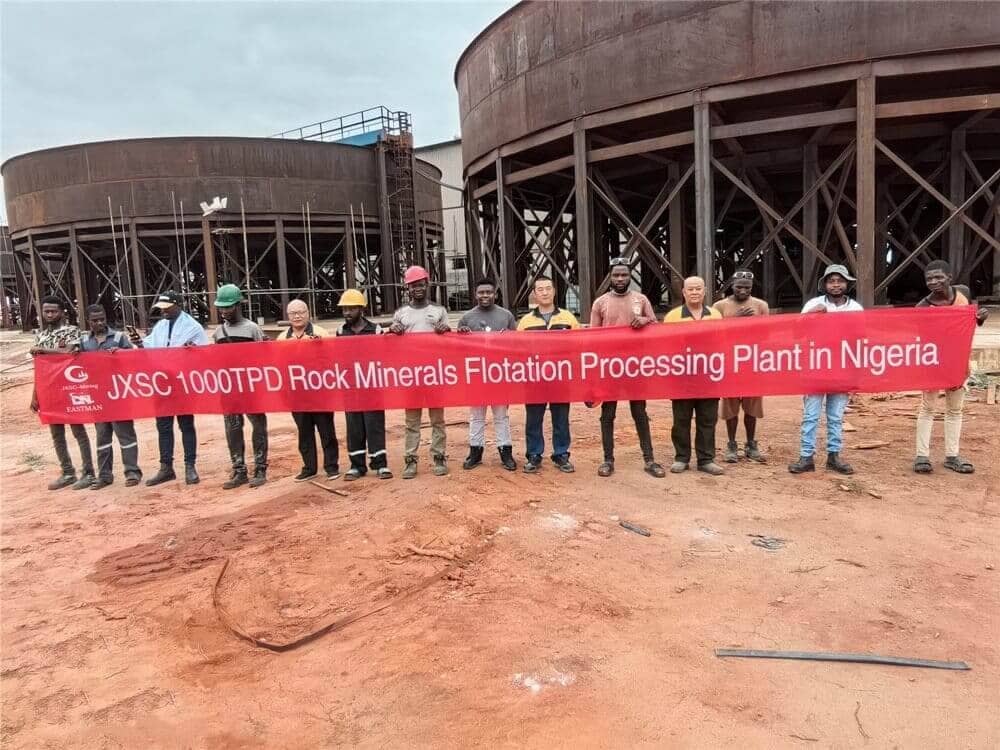
JXSC provided a successful 1,000 TPD lithium flotation plant for Nigeria’s client. It was responsible for the processing plant design, equipment configuration, and overall beneficiation flow planning, aiming to improve lithium recovery efficiency, reduce operating costs, and ensure stable plant operation. It provided a complete set of plant machinery and sent engineers to the mine site. The plant is designed to produce lithium concentrate with a target Li2O grade of 5%-6%.
EPCS
Engineering, Procurement & Construction Services
Case Study: Lithium Ore Flotation Plant Project
Project Overview
Minerals
Spodumene Ore
Capacity
1000 TPD
Feed Size
≤500 mm
Location
Nigeria
Year
2024
Project Process
Solutions & Process
We designed and delivered a 1000 TPD lithium flotation processing plant for our Nigerian client in 2024, with a complete processing flow covering crushing, grinding, desliming, flotation, concentrate dewatering, and tailings treatment, along with all necessary auxiliary equipment. We supplied all the equipment and sent engineers to the site to help them install the plant.
Key highlights of this project include:
- 1000 TPD Processing Capacity: A complete spodumene flotation beneficiation plant designed to meet the production requirements of the Nigerian lithium mining project.
- Three-Stage Crushing System: Reduces raw ore from 0-500 mm to less than 20 mm, improving grinding efficiency and reducing energy consumption.
- Optimized Grinding and Desliming: The ball mill and spiral classifier form a closed-circuit grinding system, while hydrocyclone groups remove fine mud to improve flotation conditions.
- Multi-Stage Flotation Process: Includes mica removal, roughing, scavenging, and cleaning to improve lithium recovery and concentrate quality.
- High-Quality Lithium Concentrate: Designed to produce a final spodumene concentrate with a target Li2O grade of 5%-6%.
- Complete Dewatering System: Uses a concentrate thickener and vacuum disc filter, together with tailings thickeners and plate press filters, for efficient solid-liquid separation.
- Water Recycling System: Recovers thickener overflow water for reuse, reducing fresh water consumption and operating costs.
Process Flowchart

Process Design Solution
1. Crushing Part: Capacity 100TPH
- Feed 0- 500 mm rocks into the raw ore hopper first. The vibration feeder DN38096 will send the rock to a jaw crusher.
- After crushing, most of the smaller rocks will be around 100-150 mm and sent to the first cone crusher DN1200 to crush to around 50 mm.
- Then the smaller rocks will be sent to vibration screen 2YK1860 with 20 mm and 40 mm screens by belt conveyor.
- The rocks larger than 20 mm will be sent back to another cone crusher DN1310 to crush again, so most will be less than 20 mm.
- The rocks less than 20 mm will be transferred to an underground transfer bin before the ball mill.

Note: Since your processing capacity is big, the output rocks will be a large amount after hours, and the grinding part processing capacity is smaller than the crushing part. Therefore, based on our experience, we suggest you can make an underground space to store them as a transfer place.
Reasons and Advantages for the crushing part design:
- According to our crushing plant experience, crushing machines have a crushing rate of around 3-5; therefore, from 500 mm to less than 20 mm, it must be crushed 3 times.
- We suggest crushing to be less than 20 mm before the ball mill, it can enhance the ball mill working efficiency so that no need to use two sets of ball mills.
- The ball mill power is huge; using one more crusher and one less ball mill can save your power consumption and running costs.

2. Grinding and Desliming Part: Capacity 42 TPH
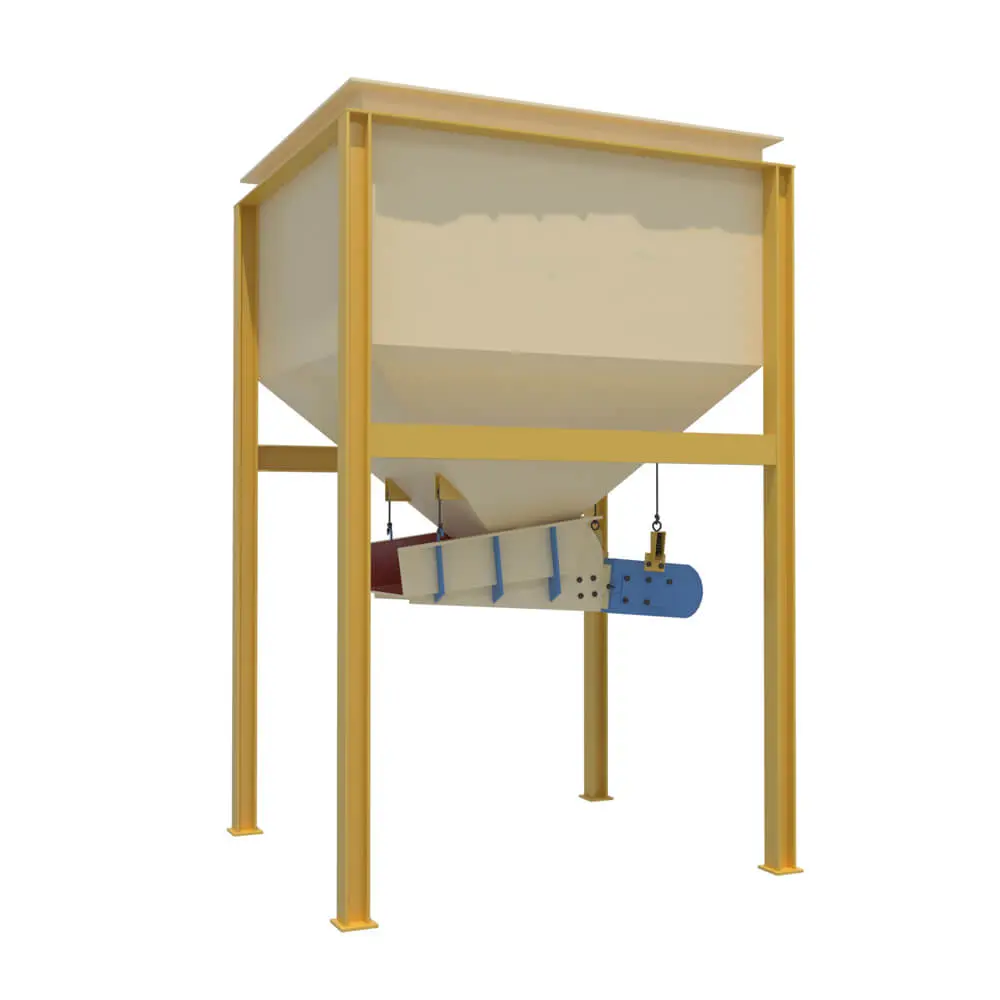
- We’ll install a feeder under the transfer bin. It’ll send the rocks to the transfer hopper before the ball mill.
- Then they’ll be transferred by the electromagnetic vibration feeder beneath the hopper to the ball mill evenly.
- The ball mill MQZ2745 will grind the less-than-20 mm rocks to 0- 1 mm (70- 80% 200 mesh, around 0.074 mm). The ball mill will be matched with a spiral classifier FG-30.
- The 0-0.074 mm materials will go to the classifier, then the classifier will send the larger than 0.074mm materials back to the ball mill to grind again. The less than 0.074mm materials will be transferred to two sets of hydrocyclone groups to de-slime the mud.
Reasons and Advantages for the Desliming part design:
After crushing and grinding, the materials contain lots of mud; the hydrocyclone group can remove the mud efficiently.
If you don’t remove the mud, in the later flotation process, you’ll need to use more chemicals to react with the mud, and this will affect the flotation machine’s running efficiency. It’ll also increase your running cost.
3. Flotation Processing Part: Capacity 42TPH
- The slurry from hydrocyclone groups will go to several sets of mixing tanks. You need to add chemicals to the tanks.
- After that, the pulp will go to the first stage of 8 flotation cells to remove mica first. If mica is not removed before lithium extraction, it will lead to low-grade lithium concentrate output.
- After removing the mica, the remaining slurry will go to the next-stage flotation machine and start the concentrate Li2O beneficiation.
- There are 3 stages for flotation: the first stage needs 4 cells for the roughing process, the second stage needs 4+4 total of 8 cells for the scavenging process, and the final part is the cleaning process, which needs 3+2+2 total of 7 cells.

4. Concentrate and Tailings Treatment Part
- After being processed by flotation machines, the concentrate will be sent to a thickener NT-18. You need to add a flocculating agent to it to accelerate the concentrate sedimentation.
- Then the concentrate will be transferred by pump from the bottom of the thickener to the vacuum disc filter to dry the 5%-6% grade Li2O concentrate.
- The tailings from the flotation machines will go to 2 sets of thickeners (NT-24) to sediment the tailings. The pump will send the tailings to the plate press filter for dewatering.
- The overflow from all the thickeners will go to a water pool. This water can be reused in the former processing part.
Related Cases
We are a leading provider of innovative and efficient mining equipment and solutions. With years of experience in the industry, we specialize in designing and manufacturing high-quality machines tailored for various mineral processing needs, including gold, diamond, copper, tin, manganese, chrome, titanium, and other ore separations. Our commitment to technology and customer satisfaction drives us to deliver customized solutions that enhance productivity and ensure environmentally sustainable practices. Explore our extensive portfolio of successful case studies and discover how JXSC can transform your mining operations, helping you maximize your profitability while minimizing your ecological footprint. Choose Us—where technology meets efficiency in the world of mining!